Tuesday, January 24, 2017

Haitian Metal Art from Global Crafts

Global Crafts News

Click on topic for a link.


We are pleased to be adding a few new designs to our Haitian Metal Art collection. Yesterday we added our samples to the site and placed the order for more. This will bring our collection to more than 200 designs. We have been carrying these pieces since 2005, adding new designs each year. Wall art is one of those lines that just continues to sell - last year alone we sold over 13,000 pieces.

The line is perfect for those hard-to-fill spaces on your walls and requires zero floor or shelf space. For us this is perhaps one of the most rewarding product lines we sell as we have watched the artisans succeed and with it show great humility and thanks for the work that your orders provide.

Yes, our Closeout sale is still on and yes there are few pieces of Metal Art in the closeout section. The prices on these items are already discounted by 30 - 50% and the coupon CLOSE16 takes a further 25% Off these items.


Best seller - Tree - of Life - Birds Metal Drum Art Wall Hanging

Six birds within the branches of a tree are depicted in this traditional Haitian tree of life design. Handcut and embossed, this piece is 24 inches in diameter.

Buy Now


School of Fish Painted Drum Art -24 inch
This 24 inch painted Haitian metal wall art features a school of fish design. The piece is cut, painted and embossed by hand.  Suitable for indoor or outdoor display.


24 inch Painted Angel and Moon
This 24 inch Haitian metal wall art features an Angel with a trumpet and the moon. The piece is hand painted, hand cut and embossed.  


.   


We know that our success is due to your success. We value your support and look forward to working to grow both of our businesses.

Many thanks

Kevin and Renice
Global Crafts  


Saturday, December 31, 2016

Global Crafts blog and Fair Trade Calendar (downloadable)

And It’s On to 2017


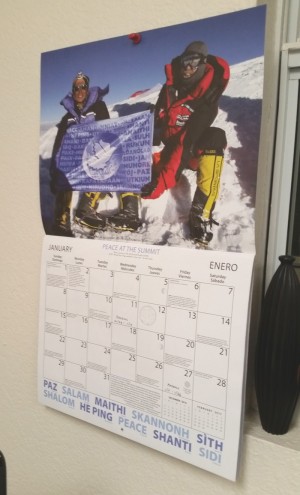
2017-peace-calendarThis year is the first in a long while that January is a big question mark for me.  I’m trying to be positive but I have no idea what US legislation and laws are going to change my life or others I care about  or what basic human rights are going to be at risk.  I know I’m not alone out there.  I find myself donating money to causes that I feel are constantly in need with aplomb.  I’m signing petitions left and right and have my national representatives on speed dial.
But my last-week-of-December traditions must go on.  Every year I buy a new wall calendar with big write-in boxes.  I then add the semi-monthly payroll dates for the whole year (our staff likes that) and wait until January 1st to hang it.  I’ve been looking for a calendar that denotes events that mean something to me and not just those designated by Hallmark.  Cultural Survival used to produce a small calendar that I could use to transfer these noteworthy events to a bigger National Geographic calendar but they stopped making the calendars for some reason.  I even emailed them suggesting they make some kind of electronic one but I didn’t hear back.
This year I stumbled upon the 2017 Peace Calendar put out by the Syracuse Cultural Workers.  There were no dimensions of the calendar but I took the chance that for $15.95, I’d be getting a wall calendar with the necessary write-in blocks.  And I was not disappointed.  In addition to calling out dates that support the principles of fair trade like Equal Pay Day (April 12th) and World Water Day (March 22nd), it also acknowledges World Fair Trade Day (May 13th this year).  I will report to them that they should update the associated website from www.ifat.org which is now a dead link but baby steps.
And while I do in my heart like the concept of a day that “protests earth-destroying consumerism” called Buy Nothing Day that coincides with Black Friday, I do run a business that needs people to buy stuff.  I guess the Syracuse Cultural Workers, whose mission “is to help create a culture that honors diversity and celebrates community; that inspires and nurtures justice, equality and freedom; that respects our fragile Earth and all its beings; that encourages and supports all forms of creative expression” yet relies on the purchases of calendars, tees, buttons, patches, etc. probably agree with me.  Maybe we can change Buy Nothing Day to Only Buy Products That Do Good Day.  With all of the online specials throughout the holiday season, it seems that Black Friday has lost some of its magic as the start of holiday shopping so why not make it a day with meaning?  Let’s replace the frenzy with thoughtfulness and start the holiday gift season on a positive note.  The day after they can buy their wall-size TVs.
I took the liberty of creating a printable calendar with a few of the notable days from my 2017 Peace Calendar that we’ll be promoting in our retail store and you are welcome to do as well.  Wishing all of you a  sane, caring, non-violent, healthy, and most important, peaceful 2017.  Hope to see some of you in Washington DC on January 21st!
Renice co-founded Global Crafts in 2002 with her husband Kevin Ward after settling in Florida after 3 years in Kenya as a Peace Corps volunteer. Creating a Fair Trade business that married her passion for artisan-made pieces and years of experience in IT finally enabled Renice to find her perfect career.


Wednesday, August 10, 2016

Want to double world food production? Return the land to small farmers!


GRAIN


22nd November 2014


All over the world, small farmers are being forced off their land to make way for corporate agriculture, writes GRAIN - and it's justified by the need to 'feed the world'. But it's the small farmers that are the most productive, and the more their land is grabbed, the more global hunger increases. We must give them their land back!


The data show that the concentration of farmland in fewer and fewer hands is directly related to the increasing number of people going hungry every day.
The United Nations declared 2014 as the International Year of Family Farming. As part of the celebrations, the UN Food and Agriculture Organisation (FAO) released its annual 'State of Food and Agriculture', which this year is dedicated to family farming.
Family farmers, FAO say, manage 70-80% of the world's farmland and produce 80% of the world's food.
But on the ground - whether in Kenya, Brazil, China or Spain - rural people are being marginalised and threatened, displaced, beaten and even killed by a variety of powerful actors who want their land.
A recent comprehensive survey by GRAIN, examining data from around the world, finds that while small farmers feed the world, they are doing so with just 24% of the world's farmland - or 17% if you leave out China and India. GRAIN's report also shows that this meagre share is shrinking fast.
How, then, can FAO claim that family farms occupy 70 to 80% of the world's farmland? In the same report, FAO claims that only 1% of all farms in the world are larger than 50 hectares, and that these few farms control 65% of the world's farmland, a figure much more in line with GRAIN's findings.
Just what is a 'family farm'
The confusion stems from the way FAO deal with the concept of family farming, which they roughly define as any farm managed by an individual or a household. (They admit there is no precise definition. Various countries, like Mali, have their own.)
Thus, a huge industrial soya bean farm in rural Argentina, whose family owners live in Buenos Aires, is included in FAO's count of 'family farms'.
What about sprawling Hacienda Luisita, owned by the powerful Cojuanco family in the Philippines and epicentre of the country's battle for agrarian reform since decades. Is that a family farm?
Looking at ownership to determine what is and is not a family farm masks all the inequities, injustices and struggles that peasants and other small scale food producers across the world are mired in.
It allows FAO to paint a rosy picture and conveniently ignore perhaps the most crucial factor affecting the capacity of small farmers to produce food: lack of access to land. Instead, the FAO focuses its message on how family farmers should innovate and be more productive.
Small farmers are ever more squeezed in
Small food producers' access to land is shrinking due a range of forces. One is that because of population pressure, farms are getting divided up amongst family members. Another is the vertiginous expansion of monoculture plantations.
In the last 50 years, a staggering 140 million hectares - the size of almost all the farmland in India - has been taken over by four industrial crops: soya bean, oil palm, rapeseed and sugar cane. And this trend is accelerating.
In the next few decades, experts predict that the global area planted to oil palm will double, while the soybean area will grow by a third. These crops don't feed people. They are grown to feed the agro-industrial complex.
Other pressures pushing small food producers off their land include the runaway plague of large-scale land grabs by corporate interests. In the last few years alone, according to the World Bank, some 60 million hectares of fertile farmland have been leased, on a long-term basis, to foreign investors and local elites, mostly in the global South.
While some of this is for energy production, a big part of it is to produce food commodities for the global market, instead of family farming.
Small is beautiful - and productive
The paradox, however, and one of the reasons why despite having so little land, small producers are feeding the planet, is that small farms are often more productive than large ones.
If the yields achieved by Kenya's small farmers were matched by the country's large-scale operations, the country's agricultural output would double. In Central America, the region's food production would triple. If Russia's big farms were as productive as its small ones, output would increase by a factor of six.
Another reason why small farms are the feeding the planet is because they prioritise food production. They tend to focus on local and national markets and their own families. In fact, much of what they produce doesn't enter into trade statistics - but it does reach those who need it most: the rural and urban poor.
If the current processes of land concentration continue, then no matter how hard-working, efficient and productive they are, small farmers will simply not be able to carry on.
The data show that the concentration of farmland in fewer and fewer hands is directly related to the increasing number of people going hungry every day.
According to one UN study, active policies supporting small producers and agro-ecological farming methods could double global food production in a decade and enable small farmers to continue to produce and utilise biodiversity, maintain ecosystems and local economies, while multiplying and strengthening meaningful work opportunities and social cohesion in rural areas.
Agrarian reforms can and should be the springboard to moving in this direction.
To double global food production, we must support the small farmers
Experts and development agencies are constantly saying that we need to double food production in the coming decades. To achieve that, they usually recommend a combination of trade and investment liberalisation plus new technologies.
But this will only empower corporate interests and create more inequality. The real solution is to turn control and resources over to small producers themselves and enact agricultural policies to support them.
The message is clear. We need to urgently put land back in the hands of small farmers and make the struggle for genuine and comprehensive agrarian reform central to the fight for better food systems worldwide.
FAO's lip service to family farming just confuses the matter and avoids putting the real issues on the table.


This opinion piece by GRAIN was first published by Reuters.


Friday, May 27, 2016

Church World Service -Imagine doing this for 6 hours a day...


Photo: CWS images
Imagine doing this for 6 hours a day...
Dear friend,
Yunis woke up at 5 a.m. every day to start her search for water. She would return home around 11 a.m. carrying her heavy burden.
That's six hours. Every single day. And then she had to start the rest of her work for the day.
In Kenya where Yunis lives, and in developing nations around the world, finding enough water for survival is nearly a full-time job. Lack of access to water is one of the greatest single factors trapping families, communities and nations in poverty.
But as Yunis' story shows, caring people like you can change all that. See how you're making a difference in her life and thousands more!
Yours in service,
Rev. John L. McCullough
President and CEO
Church World Service


This email was sent to pattyredwoodshae@sbcglobal.net by Church World Service, Inc.
28606 Phillips St, Elkhart, IN 46514-1239, US

update profile  |   unsubscribe  |  view this email as a web page

Creation Justice Ministries Newsletter Spring 2016


Read the Spring 2016 Edition of Capsules

This edition includes ideas for advocating for the Green Climate Fund, protecting the Arctic Refuge, teaching the connection between religion and science, and more.
Hi Patty,
Spring is in full swing, and the creation justice community is bustling with activity. Here's some of what you will find in the Spring 2016 Edition of Capsules:
NEWS
* Sacred Duty to Curb Methane Waste
* Prayers, paper lanterns at United Methodist General Conference climate vigil
* 121 Faith Organizations Urge Congress to Invest 750 million in Green Climate Fund
ACTION
* Take Action to support the Green Climate Fund
* Creation Justice Ministries is seeking people of faith willing to offer peaceful presence upcoming hearings on the federal coal program
* Support Alaska Native communities' struggle to defend their homeland: The Arctic Refuge
* Get involved in the Bears Ears National Monument proposal 
EVENTS
* Protecting God's Creatures: Teleconference, June 5th at 4:00pm ET
* Creating a Climate for Change Conference at the Florence Civic Center in South Carolina on June 9, 2016
* The Powerful Faith-Based Organizing for Climate Justice Conference at Pendle Hill, Pennsylvania on June 16th-19th
* Faith Network Gathering for an Inclusive Economy, July 8th in Buffalo, NY
* Endangered Species round table in: Denver, CO (July 17th) and St. Louis, MO (July 31st)
RESOURCES
* Food & Climate crisis info graphic from the Presbyterian Hunger Program
* Catechism Video Series featuring scientist in the Episcopal Church
* Solar Webinar by Presbyterian churches
* ​Presbyterian Hunger Program newsletter; perspectives on trade, ecowomanism and more!
As always, we hope these resources will be of service to your ministry. Read Capsules now.
  In hope,
  Shantha Ready Alonso
  Executive Director, Creation Justice Ministries
Connect with Us

Creation Justice Ministries
110 Maryland Ave NE #203
Washington, DC 20002
(202) 827-3975
info@creationjustice.org
www.creationjustice.org